3DChipset — The 3D Accelerator Era
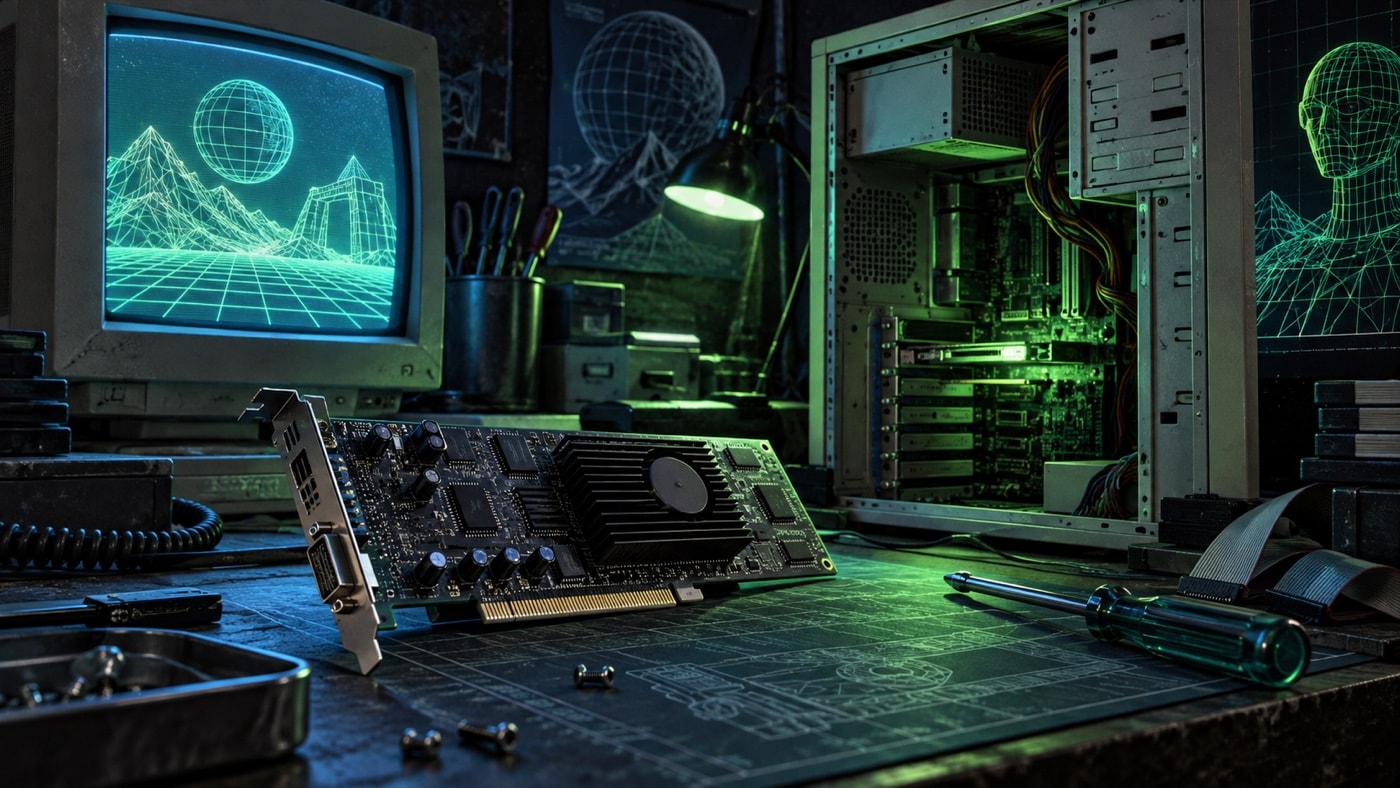
3DChipset covered the moment when the video card became the center of PC gaming conversation. From 1999 into the middle of the next decade, coverage included new 3D accelerators, driver releases, firmware experiments, utilities, reviews, graphics APIs, and benchmark debates.
A publication for the accelerator crowd
D. Richard Solomon founded 3DChipset as a direct, practical stop for readers trying to understand what was changing inside their PCs. In 1999, the publication described itself as dedicated to 3D video accelerators and as “the middlemen” for consumers interested in video cards. Its coverage quickly expanded to daily headlines, vendor-organized drivers, reviews, utilities and discussion.
Founded in 1999, 3DChipset’s 1999–2000 coverage preceded its 2001 merger with Gamers Ammo. The 2001–2002 coverage used the strapline “Ammo For The Gamer.” By late 2002 it used the line “Your Source For 3D Accelerator Information,” added comments to news items, and developed distinct driver, utility, BIOS, and forum coverage.
The hardware race it documented
The names read like a map of the period: NVIDIA RIVA TNT, GeForce, GeForce2, GeForce3, and GeForce4; ATi Rage and Radeon; 3dfx Voodoo; Matrox G400 and Parhelia; S3; PowerVR and Kyro; 3Dlabs; and Intel graphics. These were third-party companies and products covered editorially. Their presence here describes the market of the time and does not imply a support or commercial relationship.
The contest was not only about frames per second. Readers cared about 2D signal quality, texture filtering, full-scene antialiasing, transform and lighting, monitor output, video-in/video-out features, operating-system support, fan noise, power, and whether a driver behaved across the games they actually played. The graphics glossary explains the period vocabulary, while the accelerator timeline places the major families in sequence.
Before comparing two cards, decide what has to stay within reach and what can wait in parts storage. A crowded desk can leave a test notebook under the keyboard, a display angled toward a reflection, or a cable stretched across the next component swap. The gaming and hardware workbench guide walks through the chair, input devices, display, lighting, and space around the case. Use those topics to draw a simple bench plan: one place for the active system, one for loose parts, and one for readable notes. Keep the test conditions with the results so a later comparison starts from the same settings instead of a guess.
Browse by section
Reading the record safely
Old driver and firmware pages can be valuable evidence even when their binaries should not circulate. Version numbers show the cadence of graphics development; supported-card lists reveal how unified driver families grew; release notes show which features vendors were exposing. The material dates from the era. Nothing is offered for installation, and no driver or BIOS downloads are provided.
For broader historical orientation, the Computer History Museum’s graphics-and-games timeline places the 3dfx Voodoo chip among major computing milestones, while the publication’s own month pages show what enthusiasts were reading day to day. Start with March 2002 or June 2002, then follow the release records deeper into the stack.
How the sections fit together
Each section answered a different question for the same reader. News pages established what had just changed. Driver records fixed a version to an operating system and card family. Utility notes described the controls enthusiasts used to inspect or tune a system. BIOS pages documented the far riskier experiments that circulated around particular boards. Reviews supplied the broader judgment: whether those parts, tools, and releases produced a machine that was enjoyable and dependable in everyday use.
Read together, those layers show why graphics coverage became so detailed. A board was never only its processor name. Memory configuration, cooling, display output, software support, game compatibility, and the maturity of its driver branch all affected the experience. Those relationships remain useful context; obsolete binaries and hazardous procedures are not provided.